
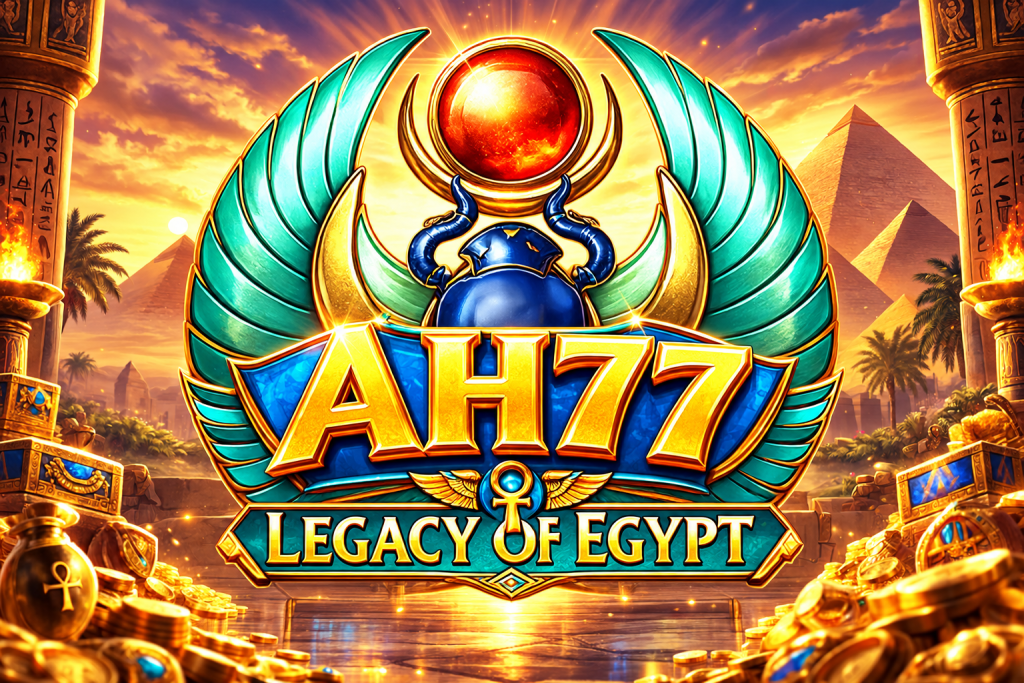
Ancient Egypt has inspired countless stories about hidden treasures, powerful symbols, and civilizations that left extraordinary monuments behind. Legacy of Egypt brings these familiar elements together in a striking visual setting, with golden pyramids, turquoise wings, and a mysterious scarab standing beneath a glowing red sun.
For readers exploring Egyptian-themed games on AH77, Legacy of Egypt offers an interesting example of how historical imagery can become the foundation of modern game design.
Rather than relying on a single mythological character, the artwork uses several recognizable Egyptian symbols to create a sense of mystery and discovery.
The Scarab: A Small Creature with a Powerful Meaning
At the center of Legacy of Egypt is a blue scarab beetle surrounded by large turquoise wings.
In ancient Egyptian culture, scarabs were closely associated with renewal, transformation, and the movement of the sun. The beetle became an important symbol in amulets, jewelry, and ceremonial objects.
Its connection to the sun came partly from the behavior of dung beetles, which roll balls across the ground. Ancient Egyptians associated this movement with the sun’s journey across the sky.
Legacy of Egypt transforms that symbolism into an elaborate fantasy design. The scarab appears beneath a glowing red sphere, while its wings spread across the image like a protective emblem.
This arrangement gives the artwork a recognizable identity without requiring a detailed storyline.
Why the Red Sun Dominates the Artwork
The glowing sphere above the scarab is one of the image’s most noticeable features.
Its warm red and orange tones contrast sharply with the turquoise wings and blue body of the beetle.
This contrast is more than a decorative choice. It draws attention toward the center of the image and creates a connection between the scarab and the sky.
In Egyptian mythology, the sun was associated with life, renewal, and the passage of time. The scarab’s connection with the morning sun makes the two symbols a natural pairing.
However, a glowing sun in promotional artwork should not automatically be interpreted as a special gameplay feature.
It may serve as a visual centerpiece rather than an object that players can collect or activate.
Pyramids, Golden Treasures, and the Atmosphere of Discovery
Behind the scarab, several pyramids rise above a desert landscape illuminated by sunset.
The foreground contains golden coins, ornate containers, and objects decorated with Egyptian-style symbols.
Together, these details create the impression of an ancient treasure chamber opening onto a vast desert.
The pyramids provide a historical reference, while the gold introduces the fantasy element commonly found in treasure-themed games.
What makes the setting effective is its balance. The background establishes a recognizable location, but the scarab remains the main attraction.
For players, this distinction is worth understanding. A treasure-filled illustration does not necessarily indicate a collection feature, and golden objects do not automatically represent high-value symbols.
Their actual functions depend on the game’s published rules.
The Ankh and the Meaning of Egyptian Symbols
Another detail in the artwork is the ankh, the cross-shaped Egyptian symbol with a loop at the top.
In ancient Egypt, the ankh was widely associated with life. It frequently appeared in religious artwork and ceremonial objects.
Its presence in Legacy of Egypt reinforces the theme of renewal already suggested by the scarab.
These symbols work together visually, even though they originally had distinct cultural meanings.
When adapted for modern electronic games, such imagery can appear as decorative artwork, ordinary symbols, or elements connected to particular features.
Players should consult the game’s symbol descriptions before assuming that an ankh or scarab has a special function.
How Egyptian-Themed Games Create Different Experiences
Egyptian-themed games often share familiar imagery: pyramids, scarabs, pharaohs, ancient temples, and golden artifacts.
Yet two games using the same historical inspiration can feel entirely different.
One may emphasize mythological characters and dramatic animations. Another may focus on ancient architecture and treasure symbols. Others may use a simpler visual style designed for quick recognition on mobile screens.
This variety is worth considering when browsing game collections on AH77 or exploring similar themes through 5S5S.
For readers interested in Egyptian-inspired titles, comparing different visual interpretations can reveal how developers use the same cultural references to establish distinct identities.
The important consideration is not simply which game displays more gold or more elaborate symbols. Clear instructions, readable interfaces, and well-explained features are more useful when evaluating the actual experience.
What Players Should Check Before Opening Legacy of Egypt
Legacy of Egypt has a strong visual identity, but artwork alone cannot explain its mechanics.
Before playing, users should review the available information about symbols, betting controls, and any special features. If the scarab, sun, or ankh has a defined gameplay role, that function should be explained in the game’s instructions.
It is also worth checking the provider and exact title, since Egyptian-themed games can share similar names and artwork.
For mobile users, symbol clarity matters particularly when detailed backgrounds and bright animations appear on smaller screens.
A visually impressive game should still make essential information easy to read.
Final Thoughts
AH77 Legacy of Egypt brings ancient Egyptian symbolism into a colorful fantasy setting built around the scarab, the sun, and the mysteries of the pyramids.
Its turquoise wings and golden desert scenery give the artwork a distinctive appearance, while the ankh and scarab provide meaningful connections to Egyptian culture.
For readers who enjoy mythology-inspired games, Legacy of Egypt demonstrates how historical symbols can shape a memorable visual experience. Whether exploring titles on AH77 or comparing similar themes on 5S5S, understanding the imagery adds another dimension to appreciating the game’s design.